
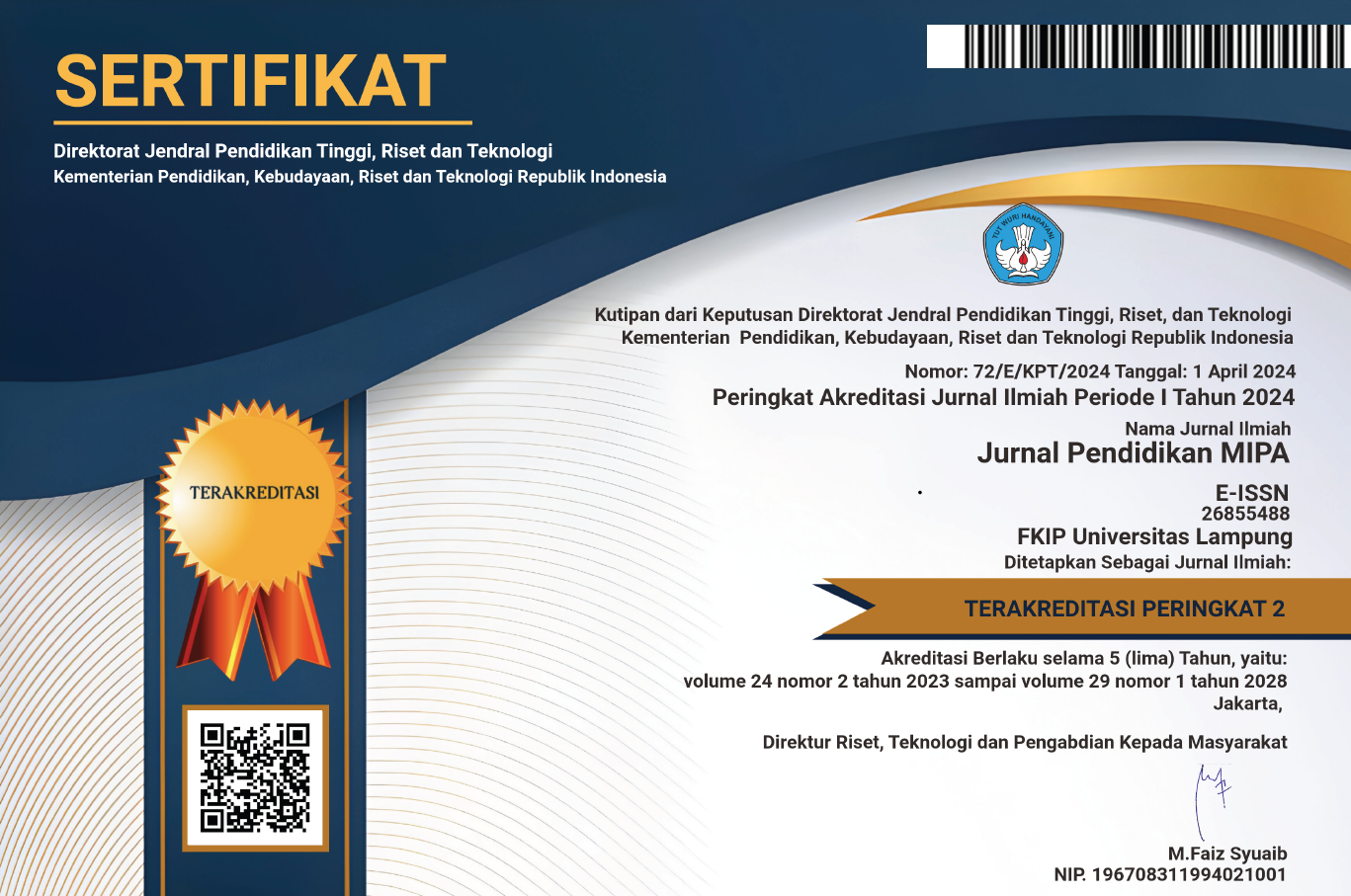

Newman’s Error Analysis of Trigonometry: Critical Thinking Perspective


Trigonometry is a fundamental topic in secondary mathematics, yet many students still experience difficulties that lead to various errors. This study applies Newman's Error Analysis (NEA) to analyze trigonometry errors and qualitatively link each error stage to critical thinking indicators. The findings show that fewer Newman’s errors correspond to stronger critical thinking performance, as S1 made minimal errors across all stages and correctly answered nearly all items aligned with critical thinking indicators. Participants were 29 grade XII students from a senior high school in Majalengka, West Java, Indonesia, selected purposively. The study employed a descriptive, qualitative design, supported by quantitative item analysis. Critical thinking skills were assessed through five open-ended trigonometry questions, aligned with reasoning, inference, clarification, and problem-solving indicators, and validated by experts for content and construct accuracy. Semi-structured interviews involved three students representing high, medium, and low ability levels. The interviews revealed that high-achieving students mainly struggled to express conclusions, while medium- and low-achieving students had broader difficulties in applying concepts and reasoning. The most frequent errors occurred in encoding (up to 100%), followed by process skills (82.7%–96.5%), moderate transformation (≤96.5%), comprehension (34.5%–100%), and fewer reading errors (86.2%). The findings indicate that NEA is effective in diagnosing students’ specific cognitive barriers and mapping their weaknesses in critical thinking. The findings show that each of Newman’s stages corresponds to critical thinking weaknesses, with reading and comprehension exhibiting weak clarification, transformation showing weak inference, process skills demonstrating weak reasoning and logical evaluation, and encoding displaying poor evaluation and difficulty in expressing conclusions. The study concludes that mathematics instruction should focus on strengthening process skills and training students in clear mathematical communication to minimize encoding errors. It also recommends integrating visual or manipulative learning media that address these errors, as many process and encoding mistakes stem from students’ difficulty visualizing angle–side relationships in trigonometric problems.
Keywords: newman’s error analysis, critical thinking, trigonometry, student errors.
Abdullah, A. H., Abidin, N. L. Z., & Ali, M. (2015). Analysis of students’ errors in solving higher order thinking skills (HOTS) problems for the topic of fraction. Asian Social Science, 11(21), 133–142.
Ahzan, Z. N., Simarmata, J. E., & Mone, F. (2022). Using Newman error analysis to detect students’ error in solving junior high school mathematics problem. Jurnal Pendidikan MIPA, 23(2), 459–473.
Anderson, L. W., & Krathwohl, D. R. (2001). A taxonomy for learning, teaching, and assessing: A revision of Bloom’s taxonomy of educational objectives.
Arisoy, B., & Aybek, B. (2021). The effects of subject-based critical thinking education in mathematics on students’ critical thinking skills and virtues. Eurasian Journal of Educational Research, 2021(92), 99–120.
Aydın, U., & Özgeldi, M. (2019). The PISA tasks: Unveiling prospective elementary mathematics teachers’ difficulties with contextual, conceptual, and procedural knowledge. Scandinavian Journal of Educational Research, 63, 105–123.
Bye, J. K., Chan, J. Y. C., Closser, A. H., Lee, J. E., Shaw, S. T., & Ottmar, E. R. (2024). Perceiving precedence: Order of operations errors are predicted by perception of equivalent expressions. Journal of Numerical Cognition, 10.
Coffey, T., Duncan, E. M., Morgan, H., Lawrie, L., & Gillies, K. (2022). Behavioural approaches to recruitment and retention in clinical trials: A systematic mapping review. BMJ Open, 12(3).
Elagha, N., & Pellegrino, J. W. (2024). Understanding error patterns in students’ solutions to linear function problems to design learning interventions. Learning and Instruction, 92, 101895.
Fiskerstrand, A. (2022). Literature review – Parent involvement and mathematic outcome. Educational Research Review, 37, 100458.
Guzmán, B., Rodríguez, C., & Ferreira, R. A. (2023). Effect of parents’ mathematics anxiety and home numeracy activities on young children’s math performance-anxiety relationship. Contemporary Educational Psychology, 72, 102140.
Heta Kallio, Anna-Maija Pietil, M. J., & Kangasniemi, M. (2016). Systematic methodological review: Developing a framework for a qualitative semi-structured interview guide. Journal of Advanced Nursing, 72, 2954--2965.
Hughes, E. M., Riccomini, P. J., & Lee, J.-Y. (2020). Investigating written expressions of mathematical reasoning for students with learning disabilities. The Journal of Mathematical Behavior, 58, 100775.
Indrawati, K. A. D., Muzaki, A., & Febrilia, B. R. A. (2019). Profil Berpikir Siswa dalam Menyelesaikan Soal Sistem Persamaan Linearr [Student thinking profile in solving linear equation system problems]. Jurnal Didaktik Matematika, 6(1), 68–83.
Juan, Y.-K., & Chen, Y. (2022). The influence of indoor environmental factors on learning: An experiment combining physiological and psychological measurements. Building and Environment, 221, 109299.
Kamber, D., & Takaci, D. (2018). On problematic aspects in learning trigonometry. International Journal of Mathematical Education in Science and Technology, 49(2), 161–175.
Kenney, S., & Ntow, F. D. (2024). Unveiling the errors learners make when solving word problems involving algebraic task. Sage Open, 14(4), 21582440241299244.
Kranz, J., Baur, A., & Möller, A. (2023). Learners’ challenges in understanding and performing experiments: a systematic review of the literature. Studies in Science Education, 59(2), 321–367.
Lenz, K., Reinhold, F., & Wittmann, G. (2024). Topic specificity of students’ conceptual and procedural fraction knowledge and its impact on errors. Research in Mathematics Education, 26(1), 45–69.
Marder, J., Thiel, F., & Göllner, R. (2023). Classroom management and students’ mathematics achievement: The role of students’ disruptive behavior and teacher classroom management. Learning and Instruction, 86, 101746.
Muntazhimah, M., Prabawanto, S., & Turmudi, T. (2023). Mathematical reflective thinking type of error on Newman’s error analysis. Asian Journal of University Education, 19(1), 108–120.
Nuritasari, F., & Aini, S. D. (2023). Error analysis in solving geometry problems based on Newman error analysis reviewed from learning styles. Prima: Jurnal Pendidikan Matematika, 7(1), 15.
Nurjailam, H., Maat, S. M., & Ikhsan, Z. (2021). A systematic review on pupils’ misconceptions and errors in trigonometry. Pegem Journal of Education and Instruction, 11(4), 209–218.
Obeng, B. A., Banson, G. M., Owusu, E., & Owusu, R. (2024). Analysis of senior high school students’ errors in solving trigonometry. Cogent Education, 11(1), 2385119.
Ramadhani, S., Ismaimuza, D., Sukayasa, S., & Meinarni, W. (2024). Analysis of students’ errors in solving story problems based on Newman’s error analysis (NEA) on the subject matter of linear program in view of students’ mathematical ability. Prisma Sains : Jurnal Pengkajian Ilmu Dan Pembelajaran Matematika Dan IPA IKIP Mataram, 12(1), 110–120.
Rohmah, M., & Sutiarso, S. (2017). Analysis problem solving in mathematical using theory Newman. Eurasia Journal of Mathematics, Science and Technology Education, 14, 671–681.
Sari, Y. M., & Valentino, E. (2017). An analysis of students error in solving PISA 2012 and its scaffolding. JRAMathEdu (Journal of Research and Advances in Mathematics Education), 1(2), 90–98.
Schreiber, I., & Ashkenazi, H. (2024). The impact of various teaching methods on the knowledge of students of different genders: The case of mathematics word problems abstract. Heliyon, 10(16), e35610.
Siskawati, E., Mastur, Z., Waluya, S. B., & Junaedi, I. (2023). Mathematical comprehension improvement patterns to facilitate math problem solving for junior high school students. Journal of Higher Education Theory and Practice,
Suseelan, M., Chew, C. M., & Chin, H. (2022). Higher-order thinking word problem-solving errors made by low-performing pupils: Comparative case study across school types in Malaysia. Current Psychology (New Brunswick, N.J.), 1–13.
Taamneh, M. A., Díez-Palomar, J., & Mallart-Solaz, A. (2024). Examining tenth-grade students’ errors in applying Polya’s problem-solving approach to Pythagorean theorem. Eurasia Journal of Mathematics, Science and Technology Education, 20(12).
Tambychik, T., & Meerah, T. S. M. (2010). Students’ difficulties in mathematics problem-solving: What do they say?. Procedia - Social and Behavioral Sciences, 8, 142–151.
Tanujaya, B., Prahmana, R. C. I., & Mumu, J. (2021). Mathematics instruction to promote mathematics higher-order thinking skills of students in Indonesia: Moving forward. TEM Journal, 10(4), 1945–1954.
Valdez, F. A. O., & Taganap, E. C. (2024). Error analysis of pre-service mathematics teachers in solving verbal problems. Mathematics Teaching-Research Journal, 16(4), 6–34.
Webb-Williams, J. L. (2021). Teachers’ use of within-class ability groups in the primary classroom: A mixed methods study of social comparison. Frontiers in Psychology, Volume 12.
Younas, A., Shahzad, S., & Inayat, S. (2022). Data analysis and presentation in integrative reviews: A narrative review. Western Journal of Nursing Research, 44(12), 1124–1133.
Zhang, E. (2025). Unravelling the quality of processes of learning from errors: Insights from students’ written error reflections in factoring tasks. Learning and Instruction, 100, 102199.
No supplementary information available.
Refbacks
- There are currently no refbacks.

This work is licensed under a Creative Commons Attribution-ShareAlike 4.0 International License.