
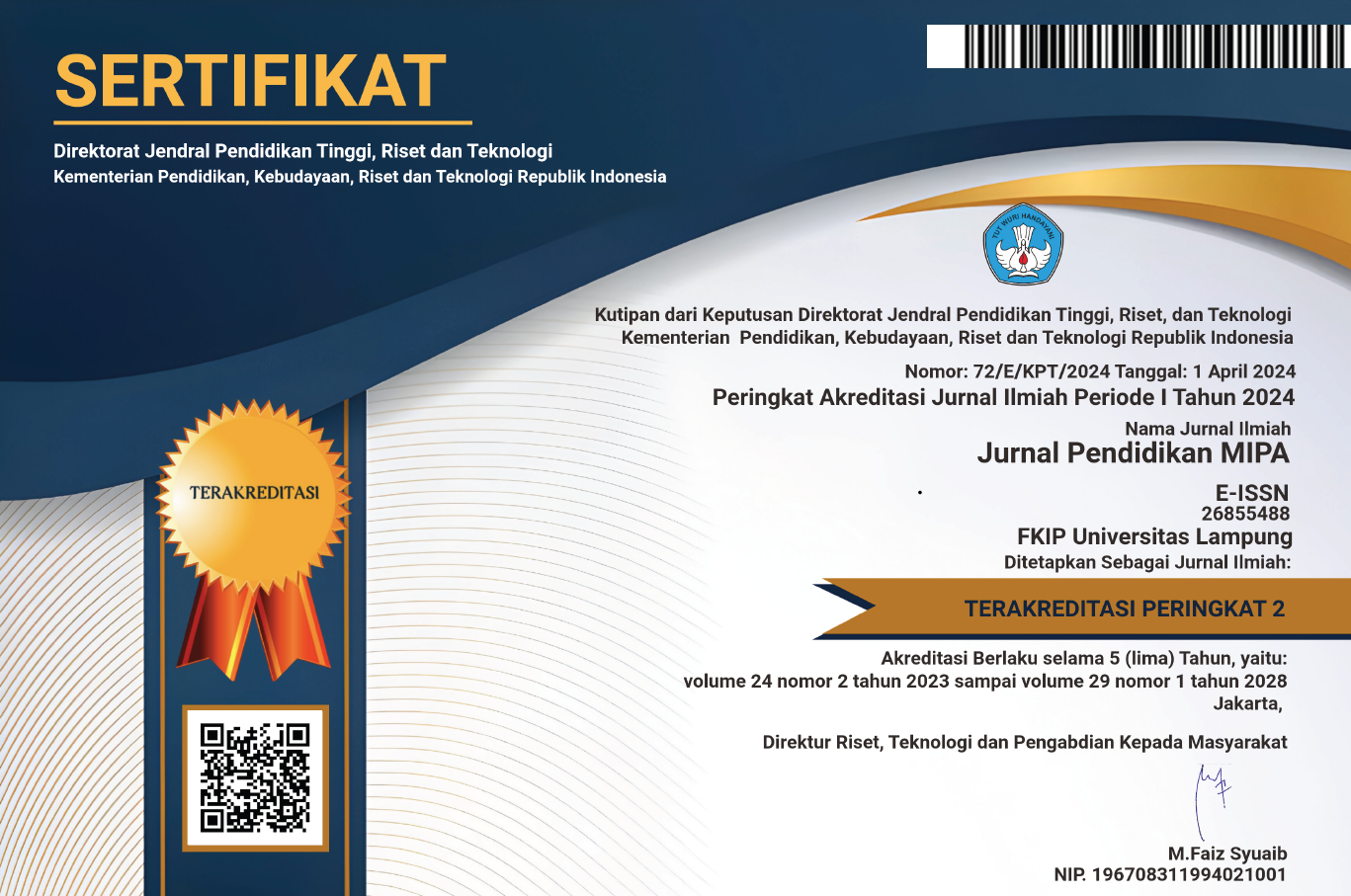

Fort Marlborough Ethnomathematics-Based Learning Handouts: Enhancing High School Students' Mathematical Literacy Skills


This study aims to develop a valid, practical, and effective learning handout based on the ethnomathematics of Fort Marlborough, Bengkulu, to enhance students' mathematical literacy. The research method used is research and development. The development model used is a formative evaluation with stages including self-evaluation, expert review, face-to-face sessions, small-group sessions, and field testing. This study involved test subjects of grade X high school students in Bengkulu City, Indonesia. The test subjects in this study were divided into several stages of the research. This study involved four experts (mathematics lecturers) from different universities. The one-to-one test stage involved six high school students (high, medium, and low abilities). The limited-scale test stage involved 24 grade X high school students, and the large-scale implementation with 43 subjects. Data collection techniques used were observation, questionnaires, and tests. Data analysis was carried out quantitatively and qualitatively. Quantitative and qualitative analyses examined the validity, practicality, and effectiveness of the mathematical literacy test. Analysis was also carried out descriptively on the results of suggestions from expert assessments of research products. The results of the study showed that: 1) the trigonometry learning handout based on the ethnomathematics of Fort Malborough Bengkulu that was developed meets the valid criteria based on the assessment of material, construction, and language by experts, with an average score of 0.63 (valid). 2) The trigonometry learning handout meets the practical criteria based on student assessment, with an average response score of 3.43 (very practical). The trigonometry learning handout has the potential to enhance high school students' mathematical literacy skills. In developing teaching materials using context, it is necessary to choose the proper context, and the illustration must be clear and easy to understand, in accordance with the material.
Keywords: learning handout, ethnomathematics, Fort Marlborough, mathematical literacy skills.
Ahyan, S., Turmudi, T., & Juandi, D. (2021). Bibliometric analysis of research on mathematical literacy in Indonesia. Journal of Physics: Conference Series, 1869(012120). doi: https://doi.org/10.1088/1742- 6596/1869/1/012120
Aiken, L. . (1980). Content validity and reliability of single items or questionnaires. Educational and Psychological Measurement, 40, 955–959.
Arsyad, A. (2016). Media Pembelajaran, edisi revisi. Rajagrafindo Persada.
Prahmana, R. C. I., & D'Ambrosio, U. (2020). Learning geometry and values from patterns: ethnomathematics on the batik patterns of yogyakarta, indonesia. Journal on Mathematics Education, 11(3), 439-456.
Direktoratdikdas. (2022). Mengkaji kembali hasil PISA sebagai pendekatan inovasi pembelajaran untuk peningkatan kompetensi literasi dan numerasi.
Drew, S. V. (2012). Open up the ceiling on the common core state standards: preparing students for 21stcentury literacy-now. Journal of Adolescent & Adult Literacy, 56(4), 321–330. doi: 10.1002/JAAL.00145
Fajriyah, E. (2018a). Peran etnomatematika terkait konsep matematika dalam mendukung literasi. PRISMA, Prosiding Seminar Nasional Matematika, 1, 114–119. https://journal.unnes.ac.id/sju/index.php/prisma/article/view/19589/9497.
Fajriyah, E. (2018). The role of ethnomathematics related to mathematical concepts in supporting literacy. In Prisma, Prosiding Seminar Nasional Matematika, 1, 114–119.
Fathani, A. H. (2016). PISA question domain for mathematical literacy. Jurnal Peluang, 1(1), 136–150. doi: http://dx.doi.org/10.30870/jppm.v14i1.9615
Febrian, D. W., Wardono, & Supriyono. (2013). Pembelajaran TGT melalui pendekatan PMRI berbantuan permainan tradisional terhadap kemampuan berpikir kreatif [TGT learning through the PMRI approach assisted by traditional games towards creative thinking skills]. Unnes Journal of Mathematics Education, 2(2), 16–24. doi: https://doi.org/10.15294/ujme.v2i2.3334
Geiger, V., Goos, M., & Forgasz, H. (2015). A rich interpretation of numeracy for the 21st century: A survey of the state of the field. ZDM, 47(4), 531–548. doi: 10.1007/s11858-015-0708-1
Holenstein, M., Bruckmaier, G., & Grob, A. (2021). Transfer effects of mathematical literacy: An integrative longitudinal study. European Journal of Psychology of Education, 36, 799–825. doi: 10.1007/s10212-020-00491-4
Jailani, Retnawati, H., Wulandari, N. ., & Djidu, H. (2020). Mathematical literacy proficiency development based on content, context, and process. Problems of Education in the 21st Century, 78(1), 80–101. doi: 10.33225/pec/20.78.80
Jehlička, V., & Rejsek, O. (2018). A multidisciplinary approach to teaching mathematics and information and communication technology. EURASIA J Math Sci Tech, 14(5), 1705–1718. doi: 10.29333/ejmste/85109
Kadir, & Masi, L. (2014). Penggunaan konteks dan pengetahuan awal matematika dalam pembelajaran keterampilan berpikir kreatif siswa [The use of context and prior mathematical knowledge in learning students' creative thinking skills]. Jurnal Pendidikan Matematika, 5(1), 52–66.
Kemendikbud. (2022). Buku saku merdeka belajar. Balai Pustaka: Balai Pustaka.
Kolar, V. M., & Hodnik, T. (2020). Mathematical literacy from the perspective of solving contextual problems. European Journal of Educational Research, 10(1), 467–483. doi: https://doi.org/10.12973/eu-jer.10.1.467
Mall, K., & Grant, M. J. (2016). Trigonomerization of optimal control problems with bounded controls. AIAA Atmospheric Flight Mechanics Conference, 1–14. doi: https://doi.org/10.2514/6.2016-3244
Mensah, F. S. (2017). Ghanaian senior high school students’ error in learning of trigonometry. International Journal of Environmental & Science Education, 12(8), 1709–1717.
Miller, T. (2018). Developing numeracy skills using interactive technology in a play-based learning environment. Miller International Journal of STEM Education, 5(3). doi: 10.1186/s40594-018-0135-2
Nieveen, N., & Folmer, E. (2013). Formative evaluation in educational design research. Netherlands institute for curriculum development Netherlands Institute for Curriculum Development: SLO.
OECD. (2013). PISA 2012 assessment and analytical framework: mathematics, reading, science, problem solving and financial literacy. Paris: Paris: OECD Publishing.
OECD. (2017). Enhancing the Contributions of SMES in a Global and Digitalised Economy. OECD Publishing.
OECD. (2019). PISA 2018 Results: What students know and can do, PISA. Paris: OECD Publishing.
Pandawa, R. M., Ridwan, A., & Mahdiyah. (2021). Analysis of the instrument content validity using the Aiken Index on disaster nursing competency assessment. Degres, 20(1), 298–308.
Pusmendik-Kemendikbud. (2019). Pendidikan di Indonesia belajar dari hasil PISA 2018.
Pusmendik-Kemendikbud. (2022). Asesmen kompetensi minimum [Minimum competency assessment]. Kemendikbud.
Retnawati, H. (2014). Membuktikan validitas instrumen dalam pengukuran. Retrieved from http://www.evaluation-edu.com
Risdiyanti, I., & Prahmana, R. C. I. (2020). Ethnomathematics teori dan. implementasinya-suatu pengantar. Yogyakarta: UAD PRESS.
Samo, D. D., Darhim, & Kartasasmita, B. G. (2018). Culture-based contextual learning to increase problem-solving ability of first year university student. Journal on Mathematics Education, 9(1), 81–93. doi: https://doi.org/10.22342/jme.9.1.4125.81-94
Sarwoedi, S., Marinka, D. O., Febriani, P., & Wirne, I. N. (2018). Efektifitas etnomatematika dalam meningkatkan kemampuan pemahaman matematika siswa [The effectiveness of ethnomathematics in improving students' mathematical understanding abilities]. Jurnal Pendidikan Matematika Raflesia, 3(2), 171–176. doi: https://doi.org/10.15294/ujme.v2i2.3334
Stroyer, A., Nainggolan, J., & Hutabarat, I. (2018). Exploration of ethnomathematics of house and traditional music tools biak-papua cultural. Jurnal Ilmiah Pendidikan MIPA, 8(3), 175–184. doi: http://dx.doi.org/10.30998/formatif.v8i3.2751
Sumirattana, S., Makanong, A., & Thipkong, S. (2017). Kasetsart journal of social sciences using realistic mathematics education and the DAPIC problem-solving process to enhance secondary school students ’ mathematical literacy. Kasetsart Journal of Social Sciences, 38(3), 307–315. doi: 10.1016/j.kjss.2016.06.001
Susanta, A., Sumardi, H., Susanto, E., & Retnawati, H. (2023). Mathematics literacy task on number pattern using Bengkulu context for junior high school students. Journal on Mathematics Education, 14(1), 85–102. doi: 10.22342/jme.v14i1.pp85-102
Susanta, A., Sumardi, H., & Zulkardi, Z. (2022). Development of e-module using Bengkulu contexts to improve literacy skills of junior high school students. Jurnal Pendidikan Matematika, 16(2), 171–186. doi: 10.22342/jpm.16.2.17698.171-186
Susanta, A., Susanto, E., & Maizora, S. (2021). The level of junior high school students’ thinking in solving TIMSS mathematical problem in bengkulu. Proceedings of the International Conference of Mathematics and Mathematics Education (I-CMME 2021), 597, 9–13. doi: 10.2991/assehr.k.211122.002
Susanto, E., Fransiska, H., & Susanta, A. (2023). Students ’ numerical ability on minimum competency assessment in junior high school. 6(1), 47–53.
Susanto, E., & Retnawati, H. (2016). Mathematics learning tools with PBL characteristics to develop HOTS for high school students. Jurnal Riset Pendidikan Matematika, 3(2), 189–197. doi: 10.21831/jrpm.v3i2.10631
Susanto, E., Susanta, A., Rusnilawati, & Ali, S. R. (2024). Developing STEAM-teaching module in supporting students’ literacy ability in elementary school. Jurnal Pendidikan Matematika (JPM), 18(3), 349–366. Doi: 10.22342/jpm.v18i3.pp349-366
Tessmer, M. (2013). Planning and conducting formative evaluations. Routledge: Routledge.
Tutak, A. (2017). The relationship between teacher efficacy, and students’ trigonometry self-efficacy and achievement. International Journal for Mathematics Teaching and Learning, 18(1), 66–83.
Wahyuni, A., Aji, A., Tias, W., & Sani, B. (2013). Peran etnomatematika dalam membangun karakter bangsa: penguatan peran matematika dan pendidikan matematika untuk indonesia yang lebih baik. Makalah Seminar Nasional Matematika, 111–118. doi: https://doi. org/10.31004/basicedu. v5i3
Wijaya, A., Dewayani, S., Effendi, A., & Gunawan, H. (2021). Framework asesmen kompetensi minimum (AKM). Pusat Asesmen dan Pembelajaran, Badan Penelitian, Pengembangan dan Perbukuan, Kementerian Pendidikan dan Kebudayaan.
Zulkardi. (2013). Designing joyful and meaningful new school mathematics using Indonesian realistic mathematics education. Southeast Asian Mathematics Education Journal, 3(1), 17–25. Retrieved from http://repository.unsri.ac.id/id/eprint/6307
Zulkardi, & Kohar, A. W. (2018). Designing PISA-Like mathematics tasks in indonesia: experiences and challenges. Journal of Physics: Conference Series, 947(1). doi: 10.1088/1742-6596/947/1/012015
Zulkardi, Meryansumayeka, Putri, R. I. I., Alwi, Z., Nusantara, D. S., Ambarita, S. M., Puspitasari, L. (2020). How students work with PISA-like mathematical tasks using COVID-19 context. Journal on Mathematics Education, 11(3), 405–416. doi: 10.22342/jme.11.3.12915.405-416
No supplementary information available.
Refbacks
- There are currently no refbacks.

This work is licensed under a Creative Commons Attribution-ShareAlike 4.0 International License.